Parse and Review Scheduled Tasks
Work from an identified Tasks directory when possible. Preserve the directory structure, source metadata and manifest before creating derived CSV output.
Prepare the evidence boundary
- Source copy
Record host/image identity, collection method, root path, timestamps, hashes and any inaccessible task files. - Derived output
Create an existing case-linked directory such asX:\SUSA-PST-072\derivedand record parser version, command, time and errors. - Time basis
Record source time zone and note which exported values are UTC, embedded XML values or file-system metadata. - Corroboration plan
Retain Task Scheduler Operational logs, payload metadata and other sources needed to test execution and attribution.
Parse the Tasks directory
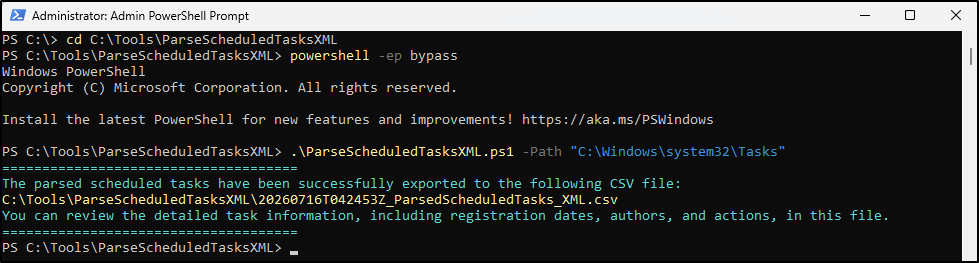
The original SUSA procedure opens an administrator PowerShell prompt, enters
the tool directory and parses C:\Windows\System32\Tasks:
cd C:\Tools\ParseScheduledTasksXML
powershell.exe -NoProfile -ExecutionPolicy Bypass
.\ParseScheduledTasksXML.ps1 -Path "C:\Windows\System32\Tasks"
For a controlled evidence copy, use the optional output parameter:
.\ParseScheduledTasksXML.ps1 `
  -Path "X:\SUSA-PST-072\source\Tasks" `
  -Output "X:\SUSA-PST-072\derived"
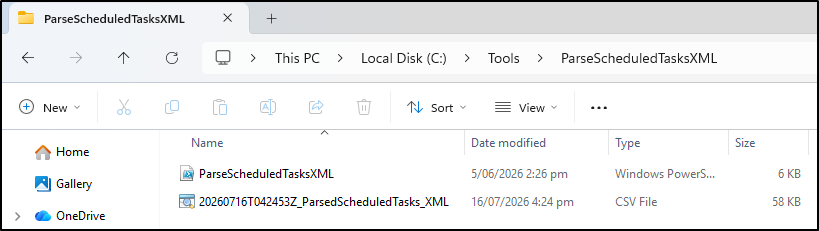
The parser recursively reads task definitions and writes a UTC-timestamped
*_ParsedScheduledTasks_XML.csv file. It suppresses individual parsing errors,
so record input counts and investigate unexplained differences between source
files and CSV rows.
Review in Timeline Explorer
Open the generated CSV in Timeline Explorer and retain the exact CSV path and hash. Start broad, then filter on fields relevant to the case question.
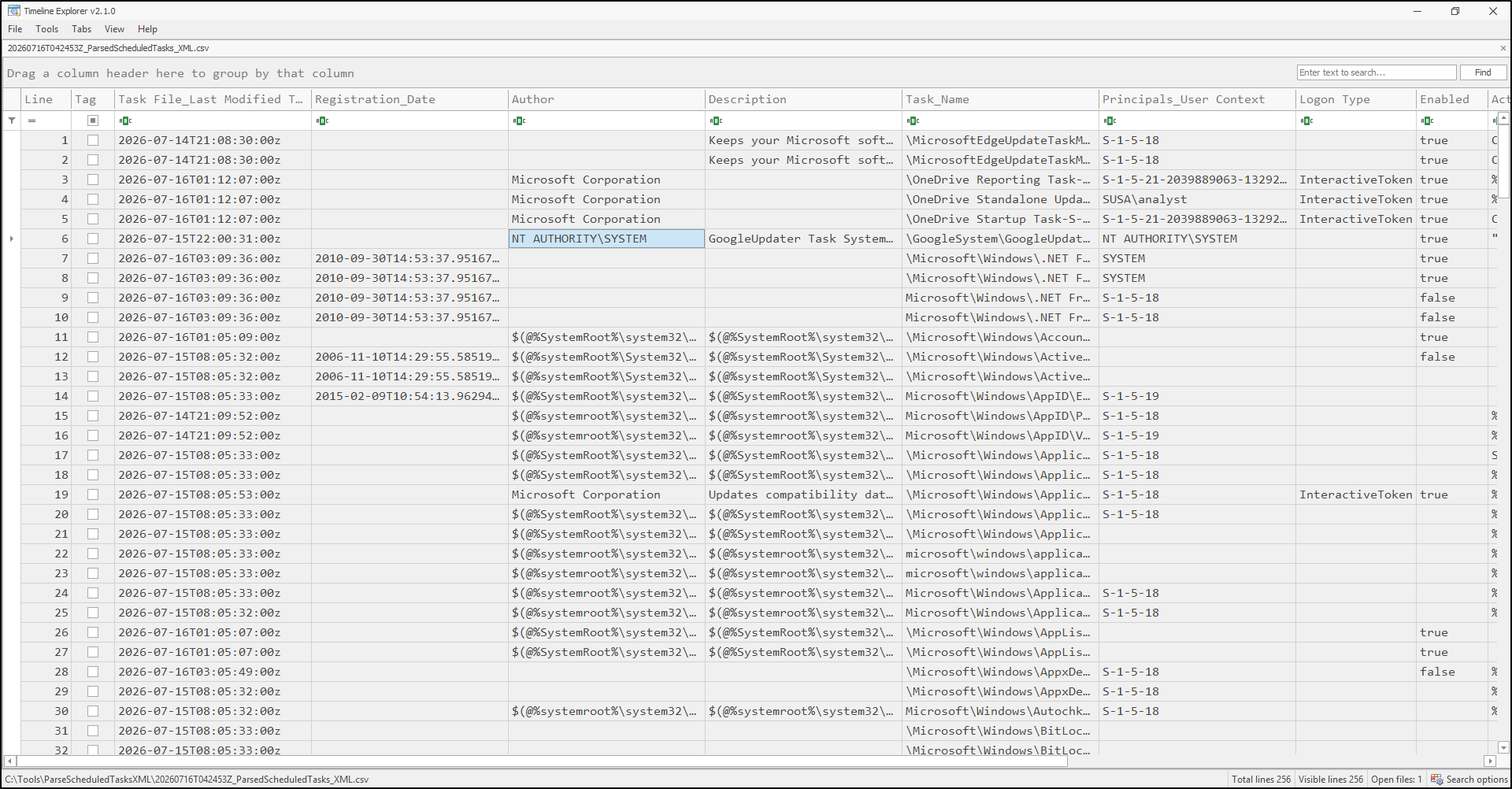
Compare vendor, Windows and organisation-specific naming patterns before labelling an outlier.
Ask whether the configured account and trigger fit the stated purpose.
Resolve paths and variables; preserve the complete string rather than a cropped value.
Use Task Scheduler Operational events and independent host evidence to test creation and execution hypotheses.
Interpret the result
| Observation | What it supports | What it does not prove |
|---|---|---|
| XML defines a PowerShell action | Configured command and arguments at collection time | That the command executed or succeeded |
Principal is SYSTEM |
Configured security context | Malicious intent or human attribution |
| Task is enabled | Definition permits scheduling under its triggers | A trigger fired during the incident |
| Registration date is present | Embedded registration value | Reliable creation time without corroboration |
Useful next sources
Correlate selected rows with Microsoft-Windows-TaskScheduler/Operational
events, the original task file and metadata, payload existence and hashes,
Prefetch or process telemetry, PowerShell logs and relevant user artefacts.
Troubleshooting
| Symptom | First check |
|---|---|
| Path validation fails | Confirm the directory exists and that the process can read it. |
| Output validation fails | Create the -Output directory before running the script. |
| CSV has fewer rows than source files | Check malformed/unreadable XML, permissions and suppressed parsing errors. |
| Action field is blank | The task may use a COM handler or another structure; inspect the source XML. |
| Times appear inconsistent | Separate file modified time, embedded registration date and source time zone. |