Collect and analyse process evidence
Use the preserved local demonstration to establish a working baseline before expanding the collection to another authorised endpoint.
Identify the process attribute you are testing: path, parent, command line, user, hash or prevalence.
Run one reviewed process module and retain the timestamped per-host TSV plus errors.
Treat unusual values as leads. Corroborate them with file, event, persistence and timeline evidence.
Demonstration: Collect Running Process Information
Scenario
An endpoint alert indicates that an unusual program may be running on a Windows workstation.
The analyst wants to collect the following process information:
- process name
- process ID
- parent process information
- executable path
- command line
- executable hash, where available
For a safe demonstration, launch Notepad and use Kansa to verify that it appears in the process results.
Launch the Test Process
Start Notepad:
Confirm that Notepad is running:
Example:
Handles  NPM(K)    PM(K)      WS(K)     CPU(s)     Id  SI ProcessName
-------  ------    -----      -----     ------     --  -- -----------
    936      42    40488     118012       2.77    864   1 Notepad
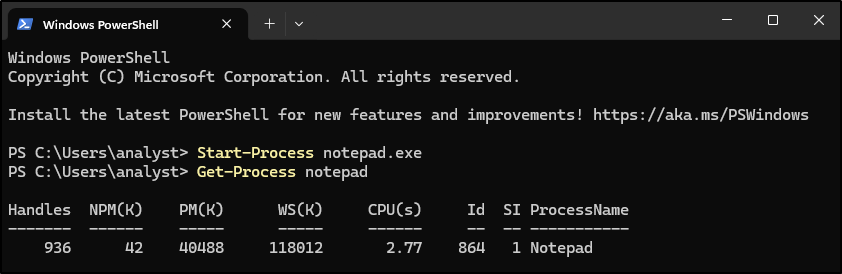
Leave Notepad running during the collection.
Confirm the Process Module Exists
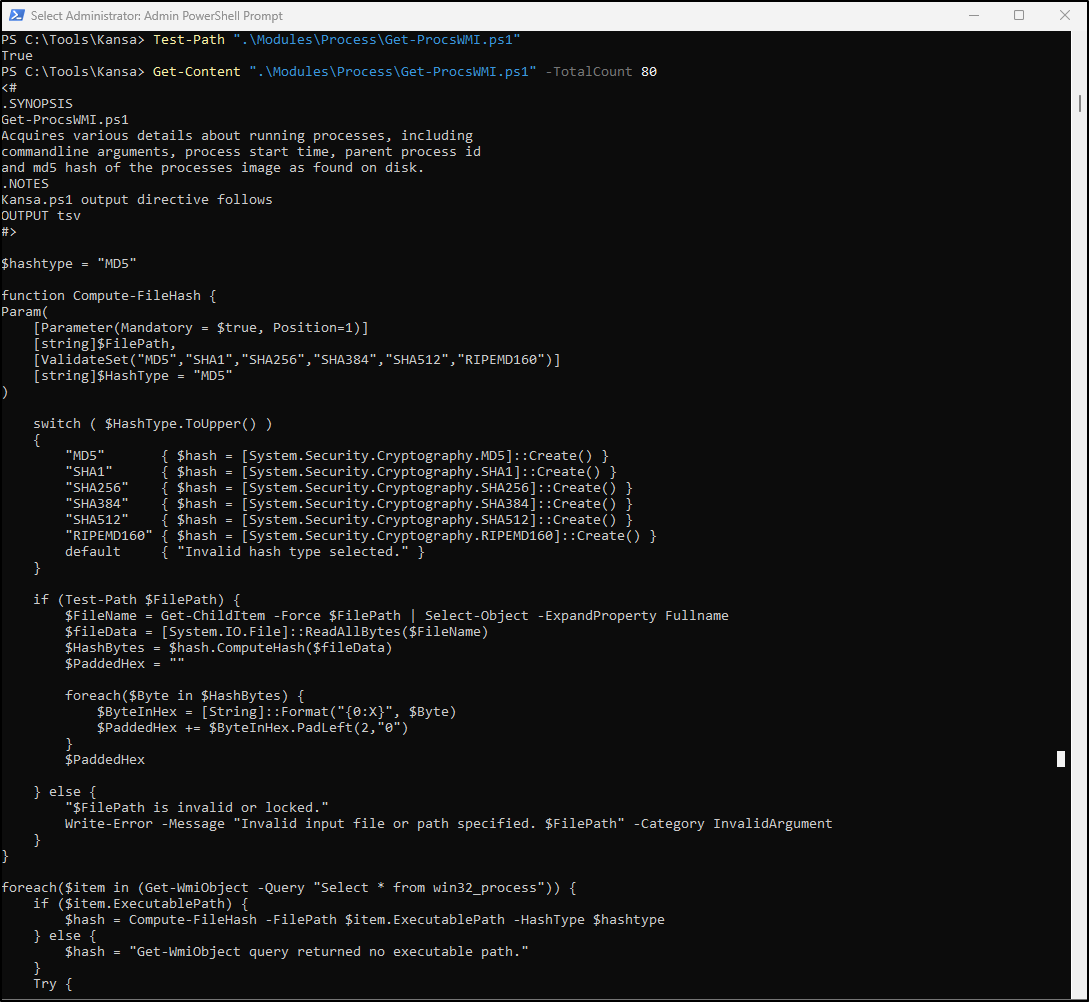
Check for the Kansa process module:
Expected result:
Review the beginning of the module before executing it:
This is a good practice when using PowerShell scripts obtained from an external source.
Run the Module Independently
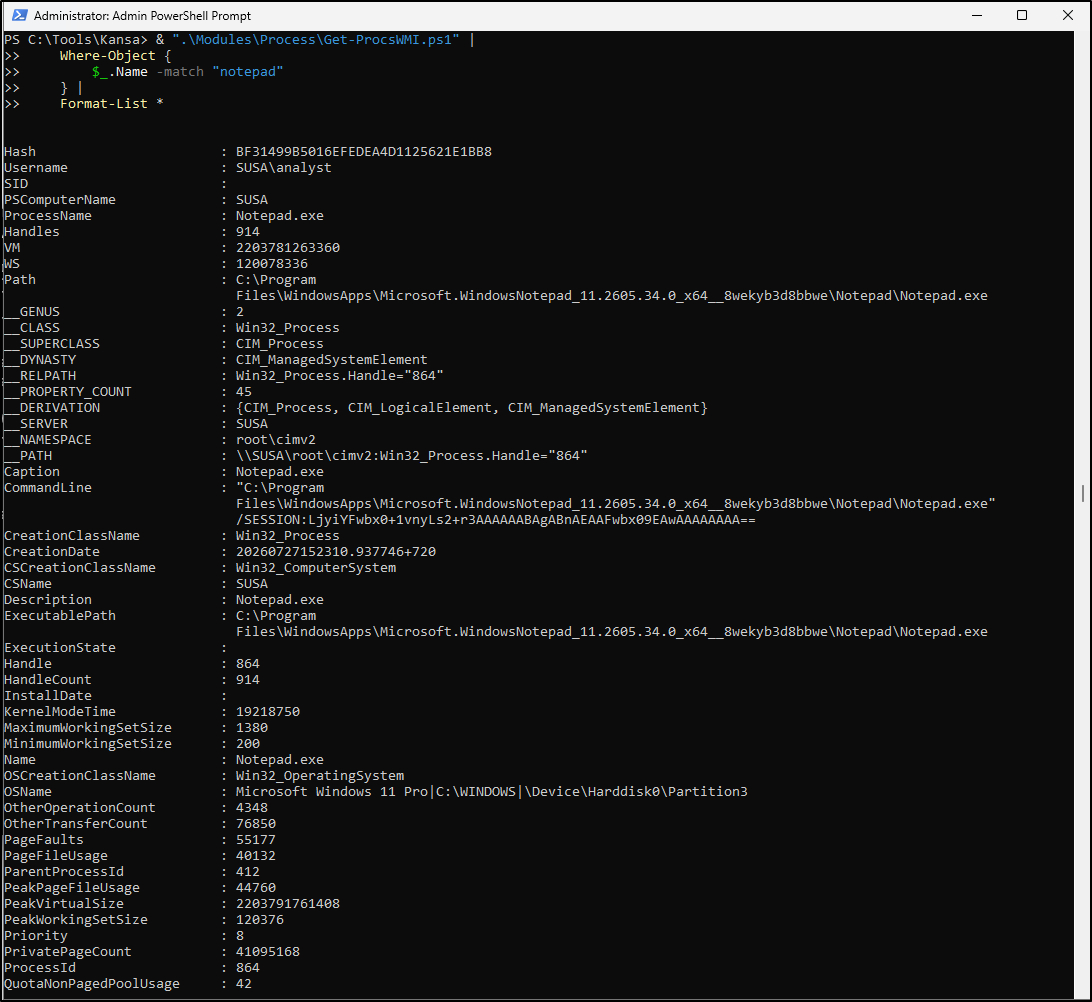
Before using the full Kansa framework, test the module as a standalone collector:
Filter the displayed output for Notepad:
The exact fields may vary by Kansa version, but the results should identify the running Notepad process.
Run the Module Through Kansa
From the Kansa directory, run:
.\kansa.ps1 -Target localhost -ModulePath ".\Modules\Process\Get-ProcsWMI.ps1" -Authentication Default -OutputFormat TSV -Verbose
Command explanation
| Parameter | Purpose |
|---|---|
-Target localhost |
Collects data from the local Windows system |
-ModulePath |
Specifies the individual collection module |
-Authentication Default |
Uses the default WinRM authentication method |
-OutputFormat TSV |
Requests tab-separated output; the module's OUTPUT tsv directive also specifies this format |
-Verbose |
Displays detailed execution information |
Example console activity may resemble:
VERBOSE: Running module:
Get-ProcsWMI
VERBOSE: Running module on machines 0 to 1 of 1 (0.0%)
VERBOSE: Waiting for Get-ProcsWMI to complete.

Locate the Output Directory
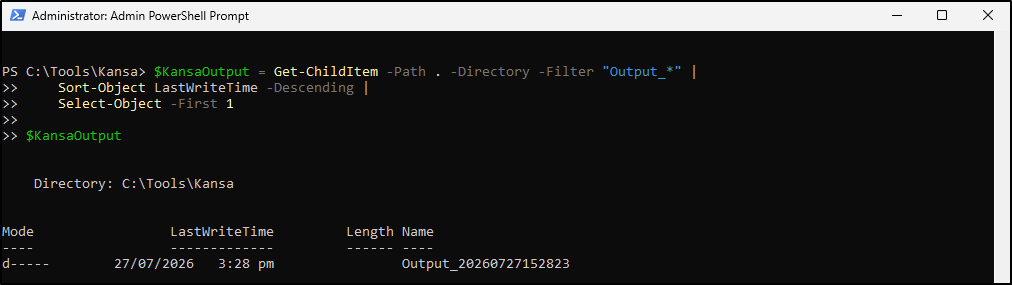
Kansa creates a timestamped output directory under its working directory.
List the most recent output directory:
$KansaOutput = Get-ChildItem -Path . -Directory -Filter "Output_*" |
    Sort-Object LastWriteTime -Descending |
    Select-Object -First 1

$KansaOutput
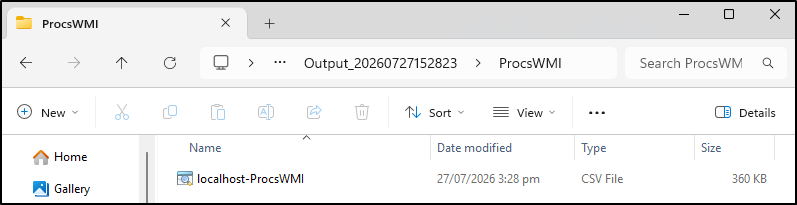
Open the directory in File Explorer:
The output structure should resemble:
The exact file and subdirectory names may differ slightly depending on the Kansa version.
Identify the Results File
Search the newest Kansa output directory for TSV files:
$ResultFiles = Get-ChildItem -Path $KansaOutput.FullName -Filter *.tsv -Recurse

$ResultFiles | Select-Object FullName, Length, LastWriteTime
Store the process result file in a variable:
Display the selected file:
Import and Review the Results
Import the tab-separated result into PowerShell:
Display the available fields:
Search for Notepad:
$Processes |
    Where-Object {
        $_.Name -match "notepad" -or
        $_.ProcessName -match "notepad"
    } |
    Format-List *
Depending on the version of the module, useful fields may include:
NameProcessIdParentProcessIdExecutablePathCommandLineCreationDateHash
The current Get-ProcsWMI.ps1 module attempts to calculate an MD5 file hash and adds user and SID context. A blank or unavailable field is not proof that no executable or user exists; access, process lifetime and module behaviour can all affect the result.
Open the TSV in Timeline Explorer
When Timeline Explorer is installed:
- Open Timeline Explorer.
- Select File.
- Select Open.
- Browse to the
ProcsWMIresults directory. - Open the generated TSV file.
- Use the column filters to search for
notepad.
Alternatively, open the TSV with LibreOffice Calc and select Tab as the separator when prompted:
Interpreting Process Results
The presence of a process is not, by itself, proof of malicious activity. Review the process within the wider investigation context.
Process name
Determine whether the process name:
- matches a known Windows process
- resembles a legitimate process but contains a spelling variation
- has an unexpected or misleading name
- is associated with a known administration or attacker tool
Examples of potentially misleading names include:
Executable path
Review whether the executable is running from an expected location.
Common legitimate locations include:
Potentially suspicious locations may include:
C:\Users\Public\
C:\Windows\Temp\
C:\Users\<username>\AppData\Local\Temp\
C:\ProgramData\<unexpected-directory>\
A legitimate process name running from an unusual directory warrants further investigation.
Command line
Command-line information may reveal:
- PowerShell encoded commands
- scripts launched from temporary directories
- remote network paths
- unusual interpreter arguments
- renamed utilities
- suspicious download or execution activity
Examples requiring additional review include:
Parent-child relationships
Review whether the process was launched by an expected parent.
Examples that may warrant investigation include:
Parent-child relationships should be assessed alongside command-line, path, user and timestamp information.
File hashes
When a file hash is available, it may be used to:
- compare the executable against known-good software
- search internal threat-intelligence repositories
- compare the file across multiple endpoints
- identify systems running an identical binary
Do not upload organisationally sensitive files or hashes to public services unless permitted by policy.
From row to finding
Process names are weak identifiers. Record the full path, parent, command line, user, collection time and host before deciding whether a row is relevant. A missing row is also not proof that a process never ran: it may have exited, been hidden from the queried API or fallen outside the collector's visibility.