NtfsFileExtractor
What NtfsFileExtractor does
Guided SUSA tool journey
NtfsFileExtractor supports file-system analysis. In this guide, you will use it to extract a selected NTFS file while preserving record and path context. The procedure and screenshots provide the practical reference; the surrounding context explains what to record and how to judge the result.
Tool guide at a glance
Extract a selected NTFS file while preserving record and path context.
Verified NTFS training artefacts or a working copy of a training volume image.
A traceable file-system observation correlated by record, path, change reason, or time.
Evidence and safety
Work from copies and retain raw metadata. Do not infer user intent from one timestamp or allocation state. Record the input identifier, tool version, relevant commands or settings, time and time zone, output location, and any errors or limitations as you work.
Choose your journey
01Understand the evidenceLearn the file-system analysis concepts and limitations.Complete when you can explain what the evidence can and cannot show.Beginner · No tool required · 15–25 min 02Follow the NtfsFileExtractor guideWork through the commands, screenshots, and instructional sequence below.Complete when the documented workflow produces its expected output.Guided · SUSA workstation · Time varies 03Interactive labPractise the tool workflow in a safe browser simulation.Complete when the guided result is supported by the case evidence.Beginner · Browser only · 10–20 min 04Full LabInvestigate an authorised training scenario with fewer prompts and preserve a reviewable result.Complete when another analyst can reproduce and verify the outcome.Intermediate · Isolated lab · 45–90 min
How the labs complement this guide
The Interactive Lab is a safe browser simulation for practising the workflow and validation logic. The Full Lab is an independent exercise for an isolated, authorised environment. Confirm the installed tool version and expected output before relying on either exercise in a real case.
Accessing NtfsFileExtractor in SUSA
NtfsFileExtractor (by Joakim Schicht) is a DFIR command-line tool that extracts files directly from an NTFS volume using MFT information, even if those files are deleted or not accessible through normal Windows methods.
Extract only from a verified image or authorised working copy and direct recovered files to a separate output location. Record the source, command and tool version, hash recovered files, and treat partially recovered or deleted content as untrusted until it has been validated.
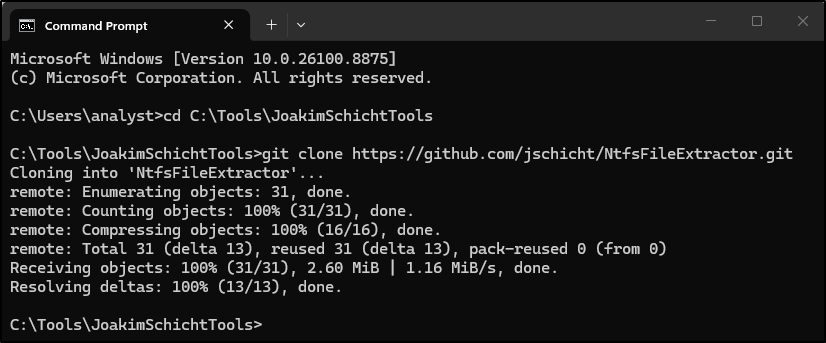
Open a command prompt and navigate to C:\Tools\JoakimSchichtTools\.
Clone the GitHub repository by running:
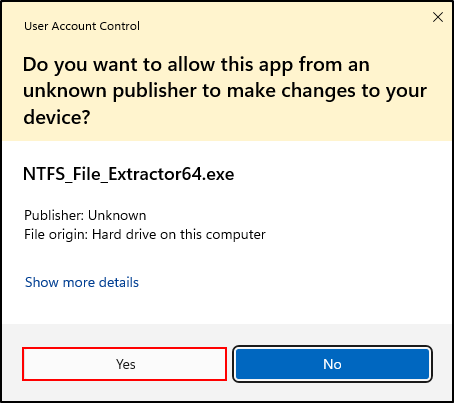
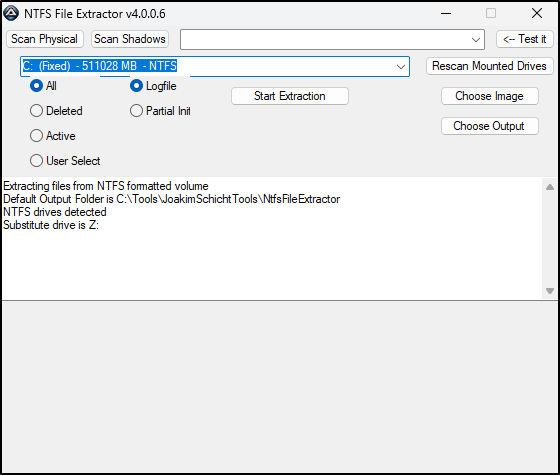
Navigate to C:\Tools\JoakimSchichtTools\NtfsFileExtractor and open NTFS_File_Extractor64 to verify the installation. Select Yes when prompted by User Account Control.